
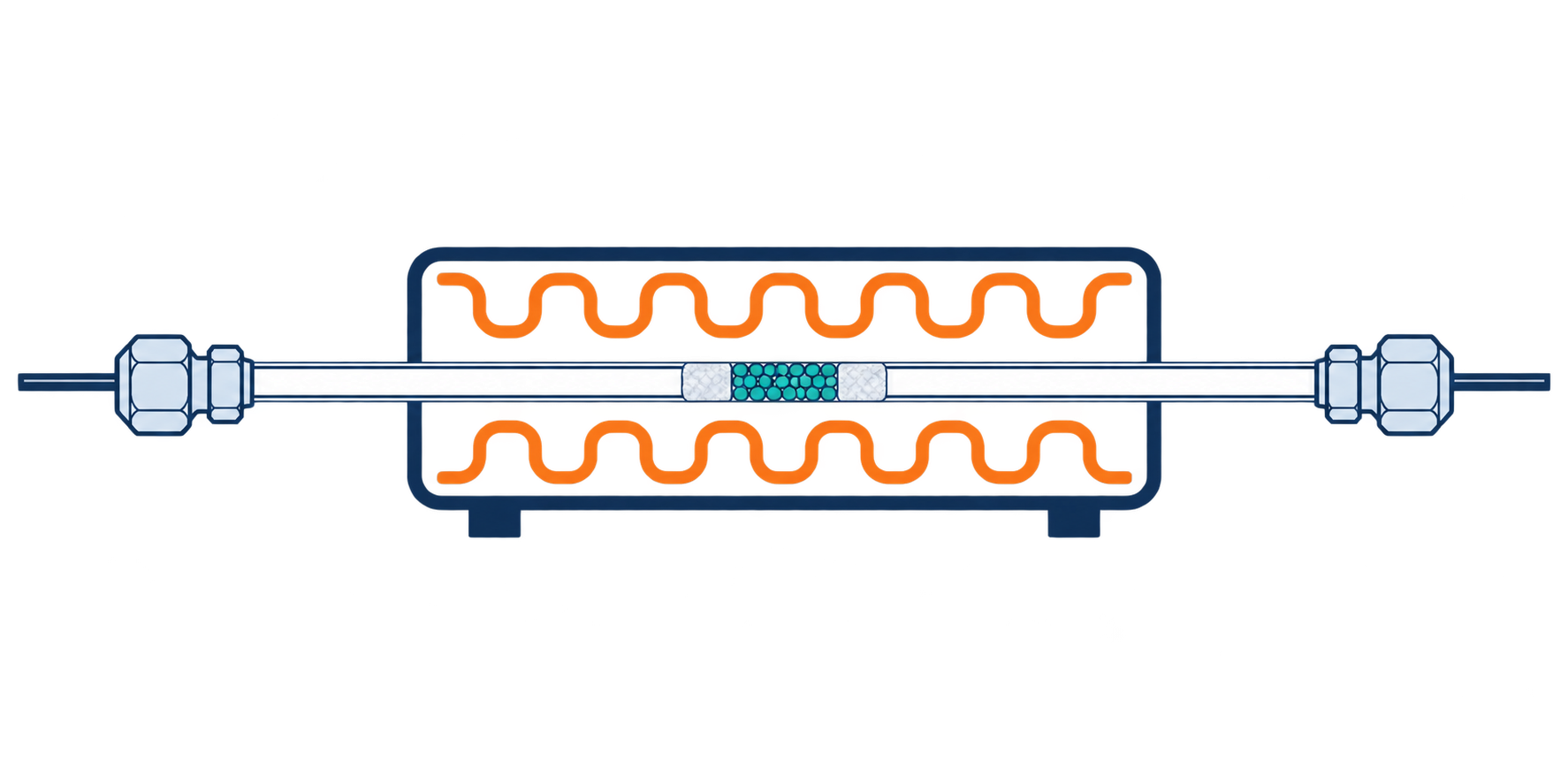
Quartz reactor tubes have a real place in bench-scale catalyst testing. University labs use them constantly for screening, yet engineers coming from industry are often surprised to see a glass tube sitting in a furnace on a working bench unit.
To be clear up front: quartz is not a material for commercial chemical or petrochemical reactors. (It does run at scale elsewhere: semiconductor and solar manufacturing use quartz process tubes.) But a lot of the data that decides whether a catalyst or a set of conditions is worth scaling comes from small tubes, and quartz is often the right material for that job. Below is what I learned building and running quartz-tube units: why they work, where they stop working, and how to connect and protect them.
Why the wall material matters in a small tube
In a small tube the wall is a large part of the reactor, so what the wall is made of matters. For a cylinder, sidewall area per unit volume is 4 divided by the inside diameter. Our standard 16 mm ID tube has about 2.5 cm² of wall per cm³ of volume.
That ratio alone does not separate lab from plant. A large single-bed vessel has far less wall per volume, but a multitubular plant reactor built from 1 to 1.5 in tubes sits within a factor of two or three of the bench tube. The bigger difference is the wall material and what it does in a short test:
- A metal wall can join the chemistry. Stainless steel contains iron, nickel and chromium, and at high temperature those surfaces can catalyze coking, cracking, hydrogenolysis or oxidation. On a bench unit, that activity can show up in your conversion and selectivity and get credited to the catalyst. Quartz takes most of that metal-wall chemistry out of the picture.
- Corrosion gets concentrated. Acidic, halogen-bearing or oxidizing feeds attack metal walls, and corrosion products can end up on the catalyst or in the effluent. Quartz handles many of these services without stepping up to Hastelloy, Monel or other exotic alloys.
Quartz is not proof that the catalyst did the work, though. Empty quartz tubes can still show real gas-phase conversion at high temperature, and quartz wool or diluent can contribute too. We ran blanks under representative conditions, starting with an empty tube and then the tube with its bed supports and diluent, before crediting any conversion to the catalyst.
The other practical bonus is that you can see the bed. After a run you can see coke patterns, color bands, bed settling, channeling and liquid holdup before you unload the tube. Things like sintering still need characterization to confirm, but what you see tells you which samples are worth sending.
What quartz gives you
Quartz earns its place on three properties: cost, chemical resistance and temperature.
Cost. In our purchasing, a custom-length fused quartz tube cost far less than the same tube in Hastelloy or Monel, and it arrived much sooner. That makes quartz tubes close to consumable. If a run fouls a tube or a campaign needs a fresh, clean wall, you replace it.
Chemical resistance. Fused quartz is nearly pure SiO2 and holds up to most acids, oxidizers, halogens and organics. It is not universal, and these are the exceptions worth knowing before you load a tube:
- Hydrofluoric acid and fluoride-bearing streams dissolve it.
- Hot concentrated phosphoric acid attacks it.
- Strong alkalis (NaOH, KOH) and alkali metal vapors attack it, faster as temperature rises.
- Alkali- or alkaline-earth-promoted catalysts can react with the wall at high temperature and fuse to it.
Temperature. Fused quartz handles temperatures that rule out most metal tubes on a bench unit. Its very low thermal expansion gives it excellent thermal-shock resistance, though wall thickness, sharp gradients and surface flaws still matter. Limits depend on the grade, so check the data for the quartz you buy. Vendors commonly cite about 1100 °C for continuous use and short exposures to roughly 1250 to 1300 °C. Those are material limits, not an allowable temperature for a loaded, pressurized reactor.
Two things happen near the top of that range. The glass devitrifies, turning cloudy and crystalline at a rate that depends on temperature, contamination (alkali especially), hydroxyl content and atmosphere. And long hot sections can sag under their own weight plus the bed, so support them.
Sourcing and sizing the tube
Most of our tubes came from Technical Glass Products, cut from their fused quartz tubing. We special-ordered each tube at the length the furnace and fittings called for, in a diameter chosen to fit our end connections.
Our standard bench tube was 19 mm OD by 16 mm ID, a 1.5 mm wall. Quartz tubing is sold in metric sizes, and 19 mm is within 0.05 mm of 3/4 in, which is why it paired with 3/4 in fittings. Nominal size is not enough on its own, though. Check the actual OD tolerance and ovality against the fitting you plan to use.
A few things to settle when you order:
- OD and tolerance. The OD has to match the fitting bore closely. A tube on the high side of tolerance may not slide in, and one on the low side leaves the seal doing more work.
- Wall thickness. A thicker wall buys pressure margin and handling toughness. It costs a little heat transfer and some bed volume for a given OD.
- Length. Leave enough tube outside the heated zone that the end seals stay cool (more on that below).
- End finish. We used fire-polished ends exclusively, and I recommend them over a raw saw cut. A fire-polished end is far less likely to start a chip when it seats in a fitting.
Pressure: keep it near atmospheric
Quartz tubes work best at atmospheric to low pressure. Every quartz unit I ran operated at a few psig, and every one had a relief device. In all that time I never had a tube overpressure or burst.
You can put more pressure on a quartz tube than that, but the published numbers do not hand you a working pressure. Momentive, whose quartz TGP fabricates from, gives a hoop-stress formula for tubing:
S = p × r / t
Here S is hoop stress (Pa), p is internal pressure above atmosphere (Pa), r is the inside radius (mm) and t is the wall thickness (mm). Momentive limits it to room temperature and says it does not apply above about 100 psi (7 × 10^5 Pa). The page gives no allowable stress for tubing (its 7 MPa figure is for discs and plates), so the formula alone cannot turn your tube dimensions into a rating.
This is a real difference from stainless tubing, which comes with published pressure ratings. Quartz tubing does not. Suppliers publish the formula, but in my experience they do not pressure-test individual tubes, so no one hands you a pressure the tube is certified to hold. The call is yours: you calculate what you think the tube can take and decide how much margin to keep. If you need more certainty than that, ask the fabricator whether they will proof-test a specific part.
Any number you calculate applies to a clean, bare tube at room temperature. Your tube runs hot with a steep gradient where it leaves the furnace, carries load from its end fittings, and may have a chipped end, a scratch from loading catalyst or a devitrified patch. That is why we stayed at a few psig.
Design for the worst credible case, not normal operation. If an upstream regulator fails open, the tube can see full supply pressure in seconds. The relief design for the unit should cover that failure flow, a plugged bed or blocked outlet, where the relief discharges, and how high pressure climbs while it is relieving.
Plan for the tube breaking anyway. A quartz tube that fails under pressure throws glass and releases everything inside it. Shield exposed sections of the tube, make sure a release goes somewhere ventilated, and give the furnace an independent overtemperature shutdown separate from its controller.
End connections
The ends are where quartz tubes actually get damaged. In my experience the common failure was never a burst; it was a chipped end where the tube seated in its fitting. I have had success with two connection styles.
| PTFE ferrule in a Swagelok compression fitting | Swagelok Ultra-Torr fitting | |
|---|---|---|
| Seal | PTFE front and back ferrules in place of metal ones (3/4 in front ferrule: Swagelok T-1213-1) | O-ring compressed around the tube by a hand-tightened nut |
| Seal material limit | PTFE; keep it well below about 200 °C | Standard FKM (Viton) O-ring, rated -31 to 204 °C; FFKM (Kalrez) is an option for harsher chemistry |
| Reuse | Ferrules deform and creep; replace them when the seal gets unreliable | Made for repeated connect and disconnect without marking the tube |
| Pressure | Swagelok recommends plastic ferrules for glass, but that is not a pressure rating for a quartz assembly; we ran these at a few psig | Swagelok designs these for vacuum service only; we ran them at a few psig, outside that stated use |
That last row is our experience, not a qualification. We ran both styles at a few psig, behind relief protection, without a problem. Neither manufacturer rates these quartz connections for positive pressure, and a hazard review plus a relief device manage that risk rather than remove it. If you go this route, keep the pressure low, follow the manufacturer’s assembly instructions for glass and plastic ferrules, and make sure a tube that pushes out of its fitting cannot hurt anyone.
Whichever you pick, a few habits prevent most chipped ends and leaks:
- Keep the fittings cool. Both seal materials fail hundreds of degrees below what the quartz can take. Let a fitting run too hot and the seal softens and starts to leak, often before anything looks wrong. Leave enough tube outside the heated zone, and check fitting temperature with a thermocouple or IR thermometer during the first heat-up.
- Keep axial load off the glass. Forcing the tube end hard against the metal inside a fitting is the classic way to chip it. Seat it the way the assembly instructions for your configuration call for, without pressing glass into steel.
- Do not overtighten. Tighten to seal and no further, especially with PTFE ferrules.
- Allow for thermal movement. Quartz barely expands when heated; the steel around it does. Design the supports and connecting lines so the tube is not pulled or pushed as the unit heats, for example with a flexible line at one end. That means flexibility in the piping, never a loose seal.
Handling and inspection
Treat a quartz tube like the pressure boundary it is, because a stainless tube forgives handling that quartz does not.
- Inspect before every run. Hold the tube up to a light and look for chips at the ends, scratches, cracks and cloudy patches. A tube with a chip at a sealing surface gets replaced, not trimmed and hoped for.
- Keep it clean. Handle quartz with clean gloves. Skin oils and salts leave alkali on the surface, and alkali speeds devitrification once the tube gets hot.
- Treat cloudiness as a warning. A white, frosted or opaque area is often devitrification, and devitrified quartz is weaker, especially on cool-down. Inspect it closely, and retire the tube if you cannot rule that out.
- Load the bed gently. Quartz wool plugs or a fused-in quartz frit support the catalyst without metal parts in the hot zone. Do not tamp the bed with a metal rod.
- Store it protected. Keep tubes in their shipping tubes or a padded rack with the end caps on until they are used.
When to move to metal
Quartz is the right call for low-pressure screening, high-temperature work, corrosive feeds and any study where wall activity could muddy the data. Move to a metal tube when:
- The chemistry needs real pressure. Most hydroprocessing and many syngas or hydrogenation studies are out of quartz range.
- You are deliberately testing a construction material, or need data under the wall conditions the plant will see.
- The feed contains fluorides, strong alkali or anything else on the exceptions list above.
- The unit will run unattended for long campaigns where a fragile boundary is a poor trade.
Used inside those limits, a quartz tube is one of the cheapest and cleanest ways to get trustworthy catalyst data at bench scale.
Sources
- Momentive: rupture calculations for fused quartz tubing
- Swagelok Ultra-Torr Vacuum Fittings catalog, MS-01-32
- Swagelok Ultra-Torr O-ring material and temperature rating (Ideal Vacuum listing)
- Technical Glass Products: fused quartz properties
- Technical Glass Products: fused quartz labware temperature rating
- Fused quartz continuous and short-term temperature limits (MachinedQuartz)
- Swagelok T-1213-1 PTFE front ferrule, 3/4 in