17 entries
Dead Legs and Dead Volume in Lab Reactor Systems
How dead legs and excess hold-up volume delay composition changes, affect reactor data, and create fouling risks, with practical ways to reduce them.
From Stuxnet to AI: Cybersecurity Lessons for Lab and Pilot Reactor Systems
Practical cybersecurity lessons for lab and pilot reactor systems: isolated networks, software updates, aging controllers, compromised HMIs, and the changing threat from agentic AI.
Quartz Reactor Tubes at Bench Scale: Why They Work and How to Use Them Safely
Practical lessons on quartz reactor tubes for bench-scale catalyst testing: material limits, sizing, low-pressure operation, end connections, and safe handling.
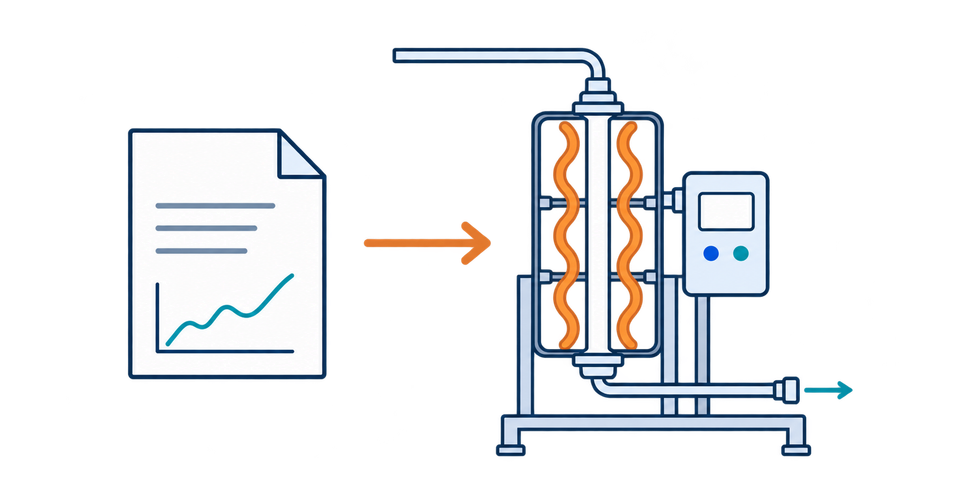
From Research Paper to Design Basis
Establish the design basis by separating research conditions, required calculations, and assumptions from information still needing confirmation.
Multipoint Temperature Probe vs. Thermowell with Individual Thermocouples
Compare flexible thermowell measurements with repeatable multipoint probes, and profile the furnace before fixing your measurement locations.
Configuring Reactor Control Loops on a Honeywell HC900
Practical reasoning behind temperature, pressure, and analog mass flow control loops on a Honeywell HC900, including strategy organization, limits, and alarms.
Fixed Gas Detectors in the Lab: Calibration, Placement, and the Alarm Nobody Believes
Practical lessons on fixed gas detector calibration, placement, alarm-loop testing, and cross-sensitivity—and why every alarm needs a credible response.
Loop Break Alarms: When the Thermocouple Isn't Where You Think It Is
How loop break alarms detect heater output without the expected temperature response, and how they complement sensor-break alarms and independent high-limits.
Getting Liquid Into the Reactor: Four Feed Systems I've Used
A practical comparison of ISCO syringe pumps, Quizix pumps, Bronkhorst Coriolis controllers, and WADose–Coriolis feed systems: pressure, flow, footprint, controls, and maintenance.
Excess Flow Valves in Practice: Swagelok, Parker, and Malema Compared
A practical comparison of Swagelok XS, Parker FS190, and Malema M-VF excess flow valves, including trip selection, reset behavior, installation, and verification.
Troubleshooting an Online GC Baseline Problem: A Real-World Case Study
A real-world case study of methodically isolating a recurring online GC baseline problem in a reactor system.
Process Device or Safety Device? The Question We Never Ask About Check Valves
Is a check valve a process device or a safety device? A shared-helium reverse-flow incident shows why the distinction matters for valve selection, maintenance, and verification.
Cold Spots on Heat-Traced Reactor Lines: Gaps, Thermal Mass, and How to Find Them
How to prevent heat-trace coverage gaps, find cold components with spare thermocouples, and set a temperature window from measured hot and cold offsets.
Where to Place the Control Thermocouple on a Heat-Traced Reactor Line
How to place a control thermocouple on a heat-traced reactor line, set the temperature window, and wrap for thermal mass.
Pressure-Decay Leak Testing a Reactor System: What Is an Acceptable Leak Rate?
A practical approach to pressure-decay leak testing lab reactor systems: test conditions, instrumentation, test boundaries, and where a 1%/hr acceptance criterion comes from.
How to Size a Furnace for a Lab-Scale Reactor
A practical guide to selecting heated length, furnace zones, bore diameter, and power for continuous-flow lab reactors.
Why Regulator Outlet Pressure Can Rise as a Gas Cylinder Empties
Why a regulator's outlet pressure can drift upward as cylinder pressure falls, and how two-stage regulation reduces the effect.
No articles, engineering notes, or videos match these filters. Try another topic or format.