
A fixed gas detector is only as good as three things: when it was last calibrated, where it was mounted, and whether people still believe it when it goes off. Get any one of those wrong and you have a box on the wall that makes everyone feel safe without making anyone safer.
I have installed and lived with quite a few fixed detectors over the years. The two I used most were the Oldham iTrans 2 and the MSA Ultima series, most recently the Ultima X5000. Between them we monitored hydrogen, H2S, carbon monoxide, methane and several other gases in labs and reactor areas.
This article covers what I learned about keeping those detectors valid, putting them in the right place, and handling the alarms that turn out not to be what they look like.
Calibration: keeping performance verified
Calibration is what verifies that a fixed detector reads and alarms correctly. Past its due date, its performance is no longer verified, and most sites treat it as impaired until it is calibrated.
The interval you follow is the shorter of two numbers: the manufacturer’s calibration requirement, or your company’s. If the manufacturer says 180 days and your site standard says 90, it’s 90. If your site standard is silent or longer, the manufacturer’s requirement governs.
The manufacturer’s guidance may not be one fixed number. It can vary by sensor type, target gas and application, and some newer transmitters allow longer intervals under specified conditions. Check the manual for your exact sensor and configuration.
A few things that are easy to miss:
- Bump test vs. calibration. A bump test exposes the sensor to a known gas to confirm it responds and alarms. A calibration adjusts zero and span so the reading is accurate. A bump test does not reset the calibration clock.
- Calibration gas has a shelf life. Expired or wrong-concentration span gas produces an inaccurate calibration. Check the cylinder certificate, not just the label.
- High exposures change things. A sensor that has seen a large release, or that has gone into alarm for an extended time, should be checked before you trust it again.
- Sensors wear out. Electrochemical cells degrade with age even when they pass calibration. Track replacement dates alongside calibration dates.
- Records are part of the calibration. Without a record of when it was calibrated, by whom, and with what gas, you can’t demonstrate that it was done.
Testing the whole alarm loop
A calibrated sensor proves the sensor works. It doesn’t prove the horn sounds, the beacon flashes, the notification reaches the people who need it, or the interlock shuts off the gas. Those functions need their own planned test procedure, run on a schedule and after any change to the system.
Transmitter configuration is part of the protection too. Alarm setpoints, relay behavior, latching and alarm-disable settings are all configurable on most modern transmitters, including the X5000, and a setting left wrong after maintenance quietly removes protection. Log any bypass or inhibit used during a test, and confirm it is restored before the system goes back in service.
Placement, part 1: how close is close enough
Where you mount the detector decides whether it will ever see the gas. A detector across the room from the leak can read zero while someone at the leak point is in a dangerous concentration.
There are really two jobs a fixed detector can do, and they need different placement:
- Leak-point detection. Right at a likely release point, the local concentration can be dangerous long before the room average moves. Fittings, regulators, valve packing, cylinder connections and reactor heads are the usual suspects. The detector needs to be close to these.
- Area detection. A slower leak can spread out and raise the concentration across the whole space. A detector placed to represent the general area catches this, but it will be late for a concentrated local release.
In many areas you need both, which means more than one sensor. When you lay them out, start from the release points on the P&ID and the physical layout, then ask where the gas will go, not where there’s a convenient spot on the wall.
In a lab, the air handling usually matters as much as the source. High air change rates, fume hood draw and supply diffusers can carry gas away from a detector that looks well placed on a drawing. Walk the room, look at where the air moves, and if you can, verify with a smoke test or a handheld survey.
Placement, part 2: mounting height
Mounting height starts from what the detector is for and how the gas will actually move: the release point, the release conditions and the room’s airflow. A heated or cold release, a high-pressure jet, a gas mixture or strong ventilation can carry a gas somewhere its density says it shouldn’t go. Watch for ceiling pockets, beams and soffits that trap light gases, and for floor drains and trenches that collect heavy ones.
Within that, density gives you a starting point. Gases lighter than air tend to rise and heavier gases tend to settle; compare the gas’s molecular weight to air’s, about 29. Treat the table below as a general starting point, not installation instructions, and check the manufacturer’s installation guidance for the specific sensor.
| Gas | Molecular weight | Density relative to air | General starting point |
|---|---|---|---|
| Hydrogen (H2) | 2.0 | 0.07 | High, near the ceiling and above the source |
| Methane (CH4) | 16.0 | 0.55 | High, near the ceiling |
| Carbon monoxide (CO) | 28.0 | 0.97 | Breathing zone, roughly 4 to 6 ft |
| Hydrogen sulfide (H2S) | 34.1 | 1.18 | Low, near the floor and in low spots |
| Ethylene oxide (EtO) | 44.1 | 1.52 | Low to breathing zone, near the source |
CO is the one people get wrong. It is so close to air in density that it mixes rather than rising or sinking, so the breathing zone is usually the right height.
Cross-sensitivity and the complacency trap
Most gas sensors respond to more than the gas on their label. An electrochemical CO cell, for example, can also respond to hydrogen and to alcohol vapors. A catalytic bead combustible sensor responds to almost anything flammable. Manufacturers publish cross-sensitivity tables, and they are worth reading before you install, not after the first alarm.
Cross-sensitivity causes alarms that look false. The real danger isn’t the nuisance; it’s what the nuisance teaches people. After the third or fourth “false alarm,” the default response becomes “it’s just that sensor again,” and the day it’s real, nobody moves.
How I’d handle it:
- Treat every alarm as real until it’s proven otherwise. Respond per the alarm procedure, then have trained responders verify with an instrument that doesn’t share the fixed sensor’s interferences. A handheld CO meter can respond to hydrogen just like the fixed one, so its agreement doesn’t confirm CO. Don’t let anyone clear an alarm on the assumption it’s a nuisance.
- Find the cause and remove it. If something in the room is tripping the sensor, move the source. Raising the alarm setpoint or bypassing the detector to stop the noise trades a nuisance for a blind spot.
- Log every alarm, including the ones you think are false: date, time, reading, what was going on. Patterns show up in the log that nobody notices in the moment.
- Pick the sensor for the room it’s in. Some sensors have filters or compensation for common interferents (hydrogen-compensated CO sensors reduce, but don’t eliminate, the response to hydrogen). If your lab runs H2 and CO side by side, ask the vendor before you buy.
The opposite failure is quieter and worse. Some compounds, silicones and some sulfur compounds among them, can poison catalytic bead sensors so they stop responding at all. Regular bump testing is how you catch a sensor that has gone deaf.
Case: hand sanitizer and a benchtop cleaner
During COVID, hand sanitizer showed up everywhere, including next to the computers in one of our labs. That lab ran a process with ethylene oxide, so it had a fixed EtO monitor. Over the following weeks the monitor alarmed on multiple occasions, and the cause turned out to be the sanitizer.
EtO is close to a worst case for this. Its exposure limits are very low, so the alarm is set at low ppm, and electrochemical EtO sensors are known to respond strongly to alcohols. A few pumps of sanitizer near the sensor released enough alcohol vapor to trip it.
The monitor was responding to alcohol, not to an EtO release. The problem was what it did to the alarm’s credibility. Every one of those alarms took people’s attention, and each one made the next alarm a little easier to dismiss.
We saw the same thing with a benchtop cleaner on a different monitor. The cleaner was used routinely, the sensor was cross-sensitive to it, and the result was another source of alarms that weren’t about the process.
The lesson from both: when you introduce a new chemical into a monitored space, even an everyday one, check it against the sensor’s cross-sensitivity data. A change in what’s sitting on the bench is a change to the detection system, whether or not anyone writes an MOC for it.
Case: the CO alarm that wasn’t CO
We had a CO monitor in a lab that alarmed at random, roughly once a month. There was no CO source in the room that matched the timing, and it was easy to file it under “that sensor.”
We found the cause by sheer coincidence. The site had just bought a new portable hydrogen detector, and a member of our ERT was testing it around the building. When they stepped out onto the roof, it picked up a high concentration of hydrogen in the air. Coming back down into the building, they found the CO alarm in the lab going off, and the two pieces finally fit together.
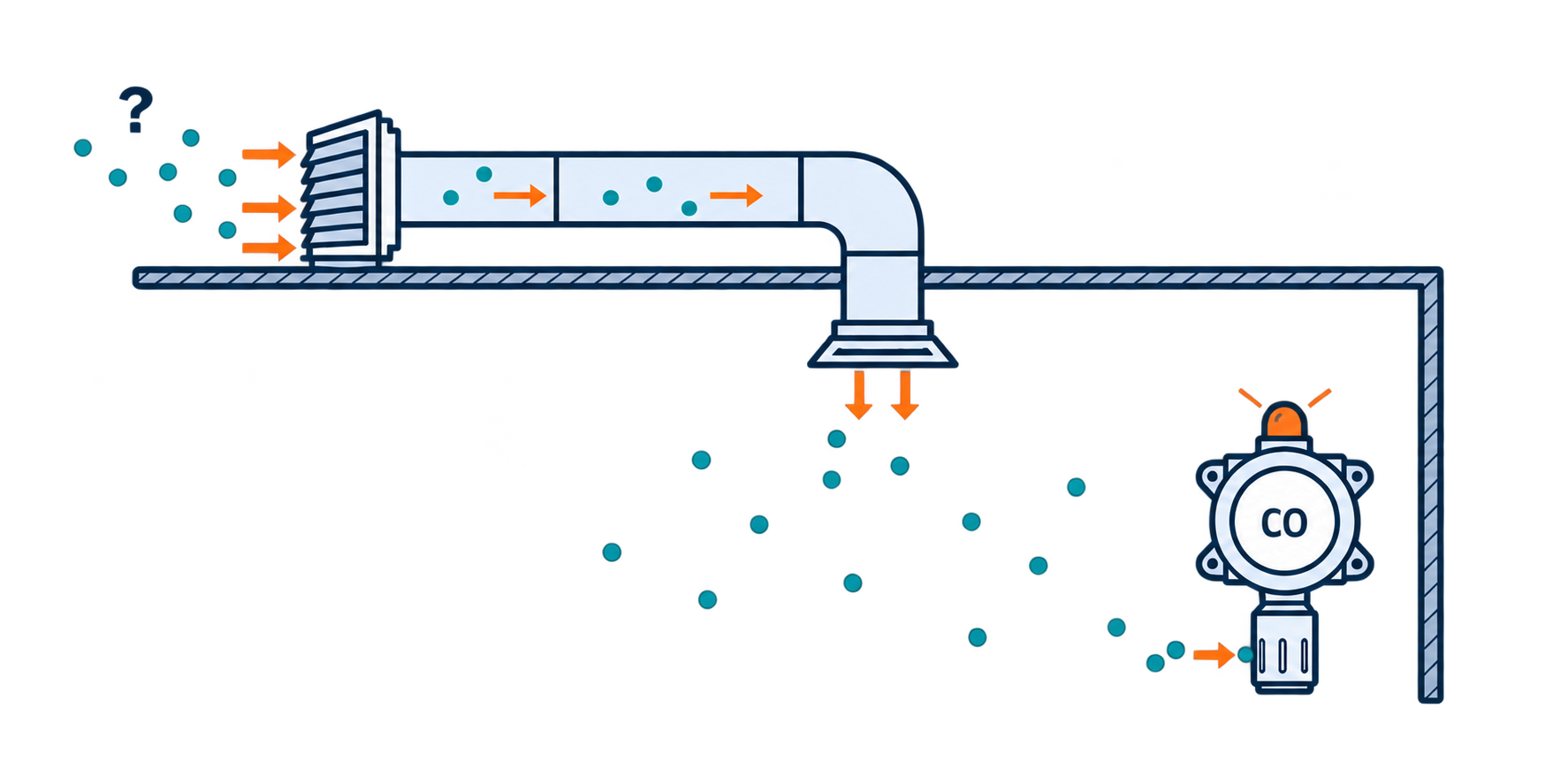
The facility next door was, at times, releasing a large amount of hydrogen. It drifted over our building as a cloud, and our air handler pulled it into the lab.
The CO sensor was responding to the hydrogen. Inside the lab, after the cloud had dispersed and passed through the air handling, the concentration was much lower than on the roof. In our assessment it wasn’t a hazard indoors, but it didn’t need to be: a CO alarm is typically set in the tens of ppm, so even a partial response to a small amount of hydrogen was enough to trip it.
So the alarm was false for CO, but it wasn’t noise. Something real was coming into the building every time, and nobody knew what until someone went looking.
What I took from it:
- A “random” alarm is a pattern you haven’t explained yet. Log the times and compare them against weather, shift changes, deliveries and anything else you can line up.
- Know what else your sensor sees. A CO detector anywhere near a hydrogen source, including one outside your fence line, can alarm on hydrogen. If hydrogen is possible, an H2-compensated CO sensor reduces the false indication, but only a dedicated H2 detector tells you hydrogen is there. A handheld CO meter would likely have read our hydrogen too; it took a different instrument to identify it.
- Your air intake is a source. In a building that pulls outside air into labs, anything upwind is part of your hazard picture, including neighbors you have no control over.
- Don’t rely on luck to investigate. We solved this one only because a new H2 detector happened to be on the roof at the right moment. Build the follow-up into the alarm response: when the cause isn’t obvious, survey beyond the room, including intakes.
Checklist for adding a fixed detector
- Identify every likely release point and the gases involved from the P&ID and the physical layout.
- Decide whether each location needs leak-point detection, area detection, or both.
- Set mounting height from the release point, release conditions and room airflow, using gas density as a starting point.
- Review the sensor’s cross-sensitivity data against everything used in the space, including cleaners and consumer products.
- Set the calibration interval to the shorter of the manufacturer’s and your company’s requirement for that sensor and application, and track sensor replacement dates.
- Define bump test frequency and who performs it.
- Test the complete alarm function (horn, beacon, notification, interlocks) under a planned procedure, and confirm any bypass is restored.
- Write the alarm response so every alarm is treated as real and verified by trained responders with an instrument that doesn’t share the fixed sensor’s interferences.
- Keep an alarm log and review it for patterns.
- Include building air intakes in the hazard review if outside air feeds the space.