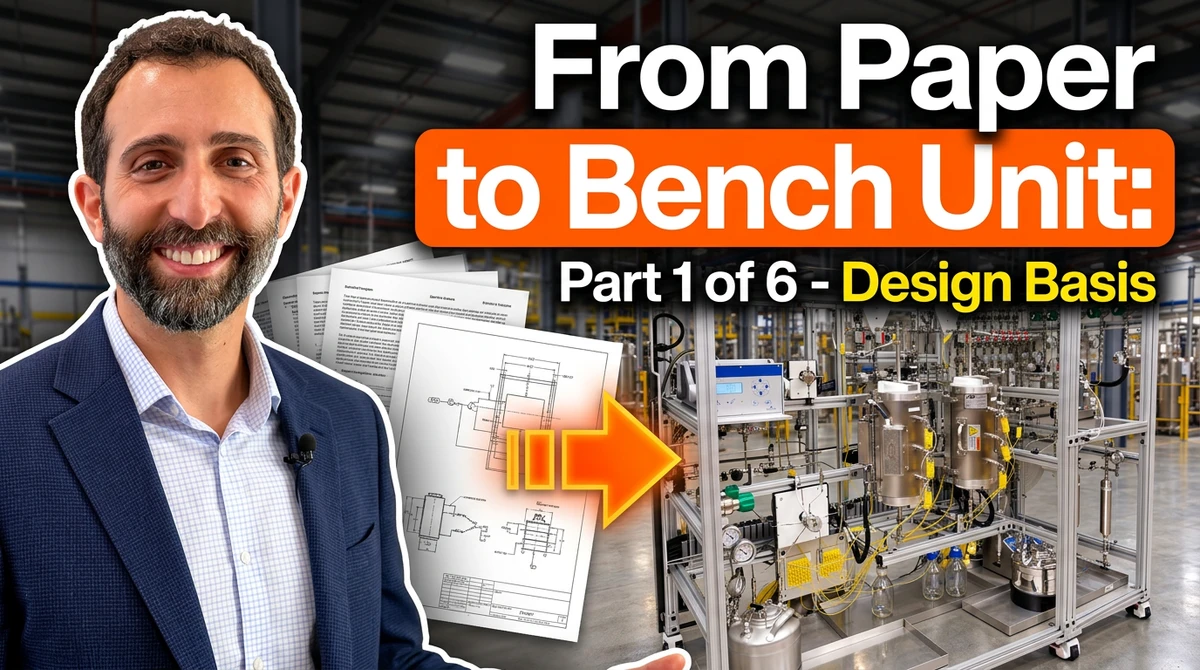
If the player fails to load, watch “From Research Paper to Design Basis” directly on YouTube.
Video chapters
Exact chapter markers have not been supplied. No estimated timestamps are shown; chapters will be added when they can be matched to the YouTube description.
Start with the basis, not the equipment
A research paper describes an experiment. A system design must also define the boundaries around that experiment: how feeds are delivered, how temperature and pressure are measured and controlled, how products reach an analyzer, and how the system responds when something departs from normal operation.
The first useful deliverable is therefore a traceable design basis, not a shopping list. Each requirement should identify its source and whether it is confirmed, an explicit design choice, or still unresolved. A reported experimental condition must not quietly become a mechanical design limit or a protective setpoint.
Scope of these companion notes: the guidance below is general engineering context, not a transcript or a reconstruction of calculations from the video. The source paper is identified below; the project-specific numerical conditions and calculation inputs remain unconfirmed. No operating values or worked results are inferred here.
Source paper
Muhammad Usman, Seetharamulu Podila, Abdulrahim A. Al-Zahrani, and Majed A. Alamoudi. “CO₂ methanation over Ni/SiO₂–Al₂O₃ catalysts: effect of Ba, La, and Ce addition.” RSC Advances, 2025, 15(14), 10958–10969. DOI: 10.1039/d4ra08895f.
What is confirmed—and what remains open
| Basis item | Confirmed by the project brief | Awaiting source confirmation or design definition |
|---|---|---|
| Chemistry | CO₂ methanation over Ni/SiO₂–Al₂O₃. | Exact catalyst formulation, preparation, activation, and experimental procedure. |
| Literature source | Usman et al., RSC Advances, 2025. Full citation above. | Review of experimental details and any supporting information for applicability to this design study. |
| Scale and duty | A bench-scale reactor design study. | Reactor dimensions, catalyst inventory, throughput, test duration, and intended experimental envelope. |
| Operating envelope | No numerical operating conditions supplied. | Temperature, pressure, feed composition, flow rates, and reference conditions for gas flows. |
| Measurements | Equipment specification and GC configuration are planned series deliverables. | Species to quantify, detection requirements, sampling conditions, calibration method, and uncertainty targets. |
| Project endpoint | A design-only study, not construction or commissioning. | Site-specific utilities, installation constraints, applicable requirements, and independent review. |
The paper’s bibliographic identity is confirmed. Its reported experimental conditions still need to be reviewed and distinguished from the requirements chosen for this project. This table is a boundary on what can be claimed, not a completed operating specification.
Make the design decisions explicit
Define the experimental question and system boundary
Decide what the unit needs to establish before defining its capacity. Catalyst comparison, reproducibility, and operation across a range of conditions place different demands on feed control, temperature measurement, and analysis. Record the intended tests and acceptance criteria rather than treating “bench scale” as a complete specification.
Draw the boundary from feed supply through effluent handling and analysis. Identify which utilities, ventilation arrangements, and waste-handling provisions belong to the installation and which belong to the unit. The eventual layout and hazard review need both sides of that boundary.
Separate reaction conditions from design limits
Document normal operation, intended experimental variation, startup, shutdown, and credible deviations separately. Equipment ratings and protective functions must be justified against the relevant design cases; copying the normal operating point is not enough.
For an exothermic hydrogen-containing reaction, heat removal, localized hot spots, loss of flow, and abnormal feed conditions deserve explicit consideration. That qualitative concern does not establish a safe temperature, relief load, or trip setting. Those require confirmed inputs and a documented analysis.
Specify what the measurements must prove
A flow indication, a furnace setpoint, and a reactor temperature are different measurements. Define the location and purpose of each measurement, then consider whether the information is sufficient to interpret the experiment. Sampling must preserve a representative stream; condensation, dead volume, and transport delay can all complicate that interpretation.
Define the species and performance needed from the gas chromatograph before selecting a configuration. Detector selection, separation, calibration, and the sample-conditioning arrangement should follow the analytical task, not an assumed standard instrument package.
Calculations: establish the inputs before the result
No numerical calculations are published here because the project’s operating basis and calculation inputs remain unconfirmed. A calculation plan can still identify the work and its dependencies:
- Material balance and feed sizing: confirm feed composition, flow reference conditions, the experimental objective, and the basis for conversion and product reporting.
- Catalyst loading and reactor geometry: establish the reported contact-time or space-velocity definition, catalyst properties, and the checks needed for flow distribution and transport effects.
- Thermal design: define reaction heat, sensible heating, losses, and credible temperature excursions before choosing furnace duty or temperature-measurement locations.
- Pressure drop and pressure protection: establish the flow path, properties, geometry, and credible pressure sources. Relief sizing belongs to a documented scenario review, not an assumed margin on normal pressure.
- Sampling and analytical performance: establish representative sampling conditions, response requirements, calibration, and the measurements needed to assess the results.
For each calculation, retain the source, units, reference conditions, assumptions, and revision history. If a missing input changes equipment selection or a protective function, keep that decision open instead of presenting the result as final.
The handoff to the process drawings
The basis should let another engineer trace a design choice back to a requirement. Carry unresolved items into the P&ID work as an open-item register, with a clear statement of what must be confirmed before each affected decision can be closed.
The planned sequence moves from developing the P&ID in Part 2 to hazard review in Part 3, components and the bill of materials in Part 4, physical layout in Part 5, and controls and commissioning in Part 6. Carry the hazard-review findings into those later design decisions and revisit them as the design develops. Commissioning is addressed as a plan for the proposed design, not work performed on a constructed unit.
Episode downloads
No downloadable files have been supplied for this episode.
Before release, every file must carry a title block with its revision number, revision date, and the design-use notice below. No unreviewed placeholder files are offered.